


This is a detailed book summary of Atomic Habits by James Clear.

A habit is a routine or behaviour that is performed regularly, and in many cases automatically. Our everyday routines, from the time we get up in the morning until the evening when we go to sleep, are filled with countless actions and choices.
What to do when we first get up, what happens when we sit down in front of our laptops, what to eat when we are hungry etc.

Habits are mental shortcuts, like a preconfigured software in our brain that tells us what to do when faced with certain situations. It allows us to act without actually thinking too much about it.
And that’s what makes habits both useful and dangerous.
Studies have shown that making decisions consciously requires energy. Habits make us act without having to make conscious decisions and that frees up a lot of brain power.
But bad habits are also dangerous. We often develop bad habits without even knowing it because it happens subconsciously and automatically.
In this book by James Clear, the author dissects the whole process of habit formation and proposes a methodology of how to build good habits and eliminate bad habits. If you want to improve your life by building better habits, we strongly recommend that you read the book.
About this summary
- All quotes are from the author, James Clear, unless otherwise noted.
- We’ve reorganised the ideas into our own themes so they are not necessarily in the order where they are presented in the book
Atomic Habits summary content: (click a link to jump to that section below)
- Atomic Habits in three sentences
- Inspirational quotes from Atomic Habits
- Key Learnings from the book Atomic Habits
- The power of aggregation of marginal gains
- Habit takes time to form an effect to our life
- habits are a double edged sword
- Why it is so hard to build habits that last
- What are habits
- Concept of atomic habits
- How habits work
- Four laws of habit formation
Atomic habits in three sentences:
- An atomic habit is a regular practice or routine that is not only small and easy to do but is also the source of incredible power; They are a set of tiny changes, marginal gains and 1 percent improvements that forms the building blocks of remarkable results; a component of the system of compound growth.
- The process of building a habit can be divided into four steps: Cue, craving, response and reward. Habit will only be formed when all four steps are fulfilled. The cue trigges a craving, which motivates a response, which provides a reward, which satisfies the craving. And over time, the response becomes associated with the cue and a habit is formed.
- To help increase the chance of sticking to a good habit or eliminating a bad habit, we can:
- Cue: Make it obvious (good habit) or make it invisible (bad habit)
- Craving: Make it attractive (good habit) or make it unattractive (craving)
- Response: Make it easy (good habit) or make it difficult (bad habit)
- Reward: Make it satisfying (good habit) or make it unsatisfying (bad habit)
Inspirational quotes from Atomic Habits
- All big things come from small beginnings. The seed of every habit is a single, tiny decision.
- Every action you take is a vote for the type of person you wish to become. No single instance will transform your beliefs, but as the votes build up, so does the evidence of your new identity.
- The ultimate form of intrinsic motivation is when a habit becomes part of your identity. It’s one thing to say I’m the type of person who wants this. It’s something very different to say I’m the type of person who is this.
- Your outcomes are a lagging measure of your habits.
- Habits often appear to make no difference until you cross a critical threshold and unlock a new level of performance.
- Success is the product of daily habits—not once-in-a-lifetime transformations.
- Time magnifies the margin between success and failure. It will multiply whatever you feed it. Good habits make time your ally. Bad habits make time your enemy.
- Goals are good for setting a direction, but systems are best for making progress. If you want better results, then forget about setting goals. Focus on your system instead.
- True long-term thinking is goal-less thinking. It’s not about any single accomplishment. It is about the cycle of endless refinement and continuous improvement.
- You do not rise to the level of your goals. You fall to the level of your systems.
- Habits are the compound interest of self-improvement. Getting 1 percent better every day counts for a lot in the long-run.
- The process of behavior change always starts with awareness. You need to be aware of your habits before you can change them
- Until you make the unconscious conscious, it will direct your life and you will call it fate.
- Many people think they lack motivation when what they really lack is clarity.
- The greatest threat to success is not failure but boredom. We get bored with habits because they stop delighting us. The outcome becomes expected. And as our habits become ordinary, we start derailing our progress to seek novelty.
- Anyone can work hard when they feel motivated. It’s the ability to keep going when work isn’t exciting that makes the difference.
- Professionals stick to the schedule; amateurs let life get in the way.
- Focus on taking action, not being in motion.
- When you’re in motion, you’re planning and strategizing and learning. When you’re in action, you are actually delivering an outcome. Motion is useful, but it never produce an outcome by itself.
- Sometimes we do it (motion, instead of action) because we actually need to plan or learn more. But more often than not, we do it because motion allows us to feel like we’re making progress without running the risk of failure.
- When working in your favor, automation can make your good habits inevitable and your bad habits impossible.
- The ultimate purpose of habits is to solve the problems of life with as little energy and effort as possible.
- Boiling water will soften a potato but harden an egg. You can’t control whether you’re a potato or an egg, but you can decide to play a game where it’s better to be hard or soft.
- You don’t have to be the victim of your environment. You can also be the architect of it.
Key ideas from the book Atomic Habits
The power of aggregation of marginal gains
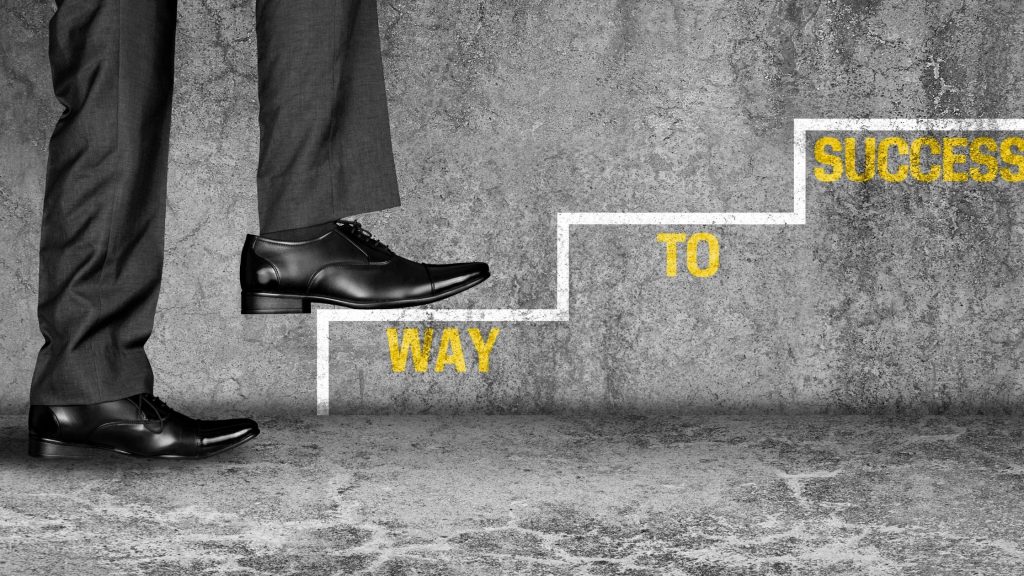
Marginal gains can be defined as a series of small, 1% marginal improvements. The theory goes like this: you break down everything you could think of that goes into your [desired outcome], and then improved it by 1%, you will get a significant increase when you put them all together.
We always overestimate the importance of one defining moment and underestimate the value of making small improvements on a regular basis. For massive success, instead of a single massive action, whats needed is a series of small improvements which can together bring in the major achievement.
Often we convince ourselves that change is only meaningful if there is some large, visible outcome associated with it. Whether it is losing weight, building a business, traveling the world or any other goal, we often put pressure on ourselves to make some earthshattering improvement that everyone will talk about.
Meanwhile, improving by just 1 percent isn’t notable (and sometimes it isn’t even noticeable).
But it can be just as meaningful, especially in the long run.
Habit takes time to form an effect to our life
“Success is the product of daily habits – not once-in-a-lifetime transformations.”
Like how money multiplies through compound interest, the effects of your habits multiply as you repeat them.
Time magnifies the margin between success and failure. It will multiply whatever you feed it. Good habits make time your ally. Bad habits make time your enemy.
Breakthrough moments are often the result of many previous actions, which build up the potential required to unleash a major change.

If you can get 1 percent better each day for on year, you’ll end up thirty seven times better by the time you are done.
Similarly, a 1% decline in performance everyday will bring you down to almost zero by the end of a year.
Habits are a double edged sword
Habits require time to bring out an effect to our lives (good or bad)
This slow pace of transformation also makes it easy to let a bad habit slide.
When we repeat 1 percent errors, day after day, these small choices compound into toxic results.
“It’s the accumulation of many missteps – a 1 percent decline here and there – that eventually leads to a problem”
Why it is so hard to build habits that last

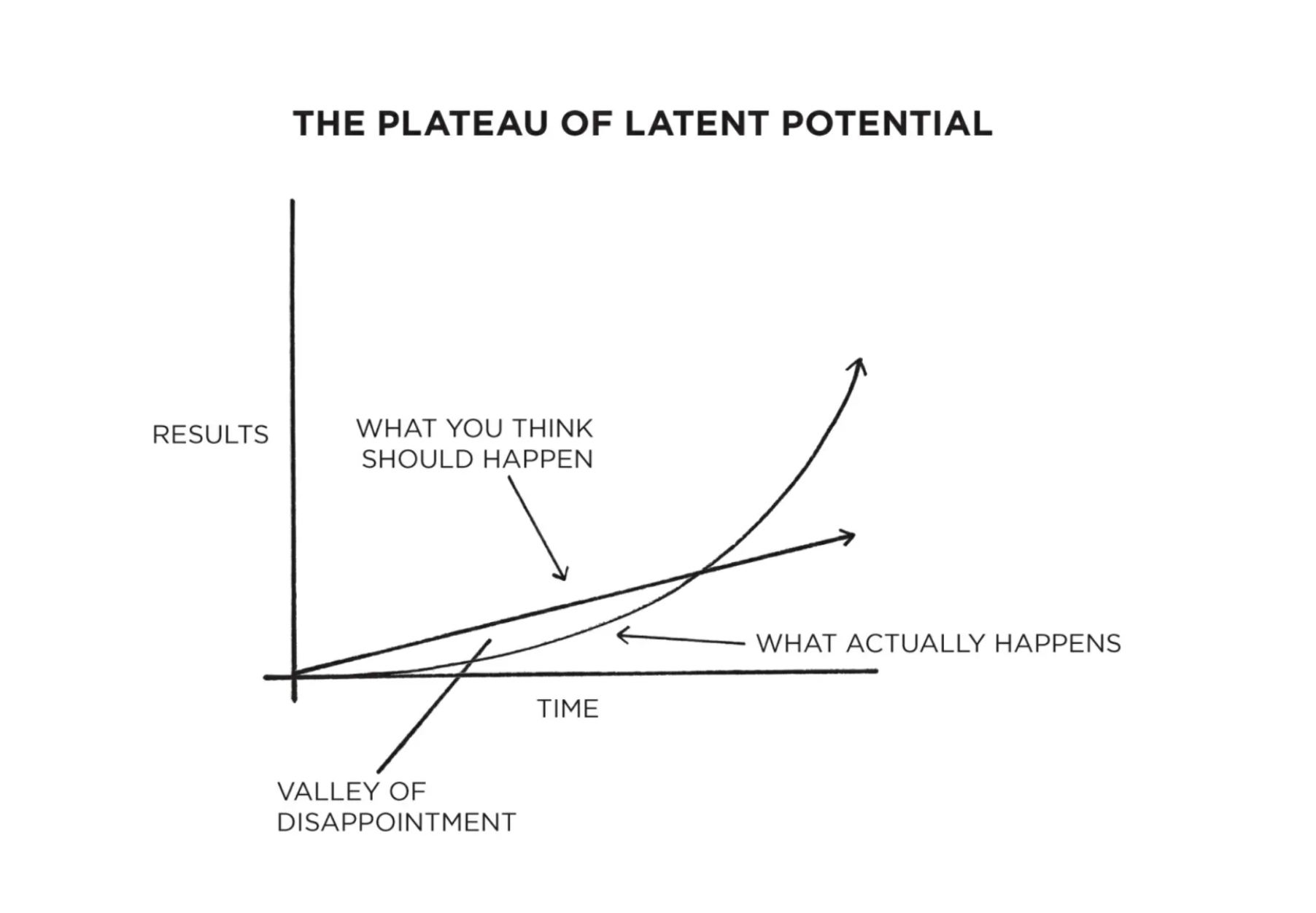
Habits often appear to make no difference until you cross a critical threshold and unlock a new level of performance.
Most people expect progress happens in a linear fashion, but habits don’t work that way.
In order to make a meaningful difference, habits need to persist long enough to breakthrough the plateau of latent potential – a period when your can’t notice any differences in life despite working very hard.
People fail at building lasting habits because they have not crossed the Plateau of Latent Potential.
If this is what’s currently happening in your life, just remember that all your work was not wasted, it’s just being stored. All the actions happen after you breakthrough the plateau of latent potential.
What are habits
A habit is a behaviour that has been repeated enough times to become automatic.
We build habits through trial and error. When faced with problems, we try different solutions until we find the best one. Our brain then tries to automate the process of solving the same problem by forming a habit.
Habits formation help preserve our brain power.
Concept of atomic habits
a-tom-ic
- An extremely small amount of a thingl the single irreducible unit of a larger system
- the source of immense energy or power
hab-it
- a routine or practice performed regularly; an automatic response to a specific situation
Just like atoms are the building blocks of molecules, habits are the atoms of our lives.
Atomic habits are regular routines that is not only small and easy to do, but also the source of incredible power. They are a set of tiny changes, marginal gains and 1 percent improvements that forms the building blocks of remarkable results
How habits work
The process of building a habit can be divided into four steps: Cue, craving, response and reward
- Cue – a trigger, or a piece of information that predicts a reward. A cue triggers our brain to initiate a behaviour.
- Craving – The motivational force behind every action we take when triggered by a cue. Cravings differ from person to person.
- Response – Action performed when faced with a cue.
- Reward – The consequence or outcome from performing a response.
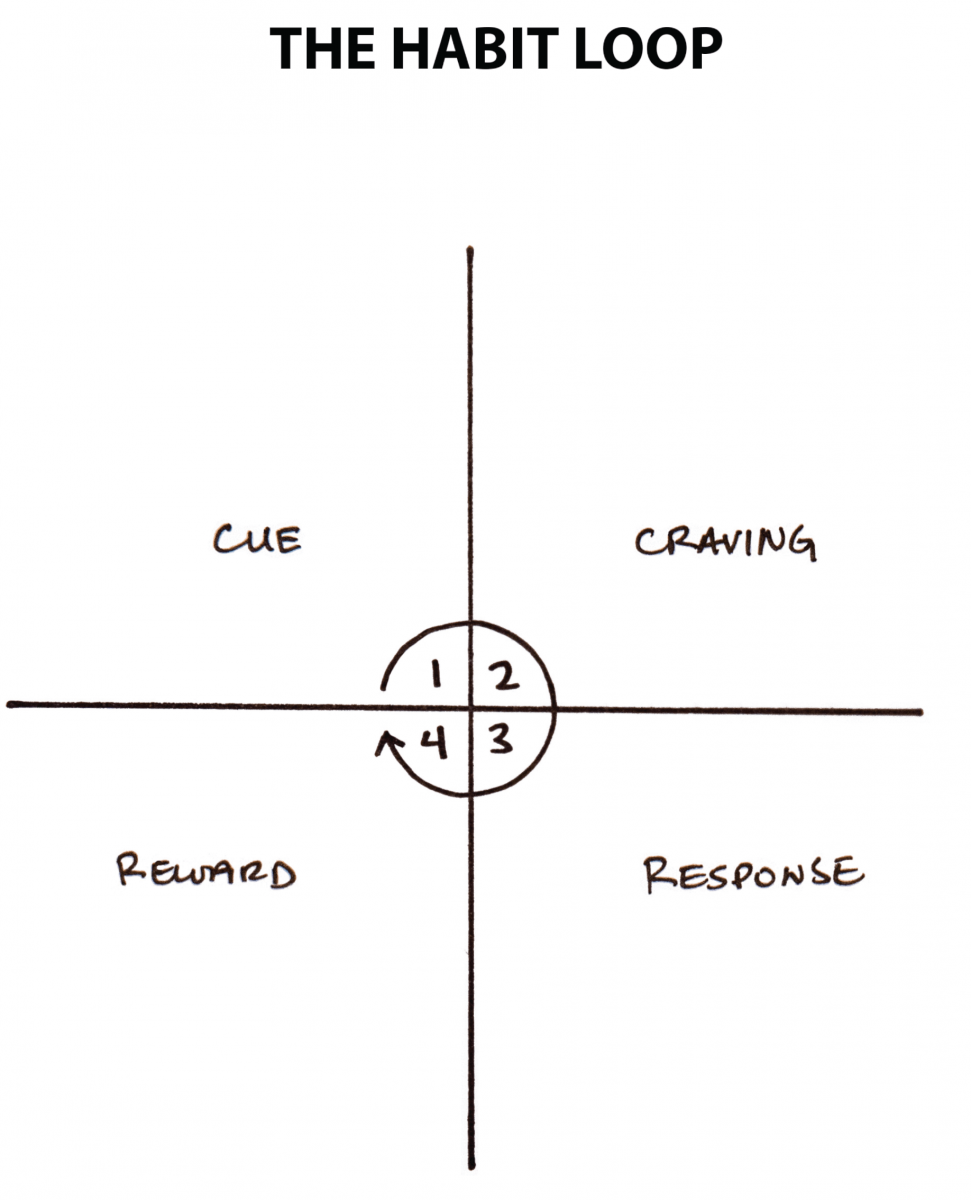
Habit will only be formed when all four steps are fulfilled. The cue trigges a craving, which motivates a response, which provides a reward, which satisfies the craving. And over time, the response becomes associated with the cue and a habit is formed.
How to make habits stick
Make it obvious (Cue)

You don’t need to be aware of the cue for a habit to begin – This is what makes habits both useful and dangerous.
Once a habit is firmly rooted in your life, we react subsconsciously and automatically, without even noticing the presence of the cues.
The first step of building new habits is to be aware of our current ones. And instead of reacting automatically, we raise the level of awareness and question why we react or behave the way we did before.
Use a habits scorecard to keep track of our habits. Habits scorecard is a list of our daily habits/routines. Score every behaviour according to whether or not they help move you towards your goal(s)
The next step is to create cues to trigger your habits.
One way is to pair your new habit with a particular time and location. You write down a plan for when and where you will perform a new habit. i.e I will [behave] at [time] in [location]. This way, time and location becomes your cue for performing a habit.
Another way is to pair your new habit with an existing habit. A method called habit stacking. If successful, your every action becomes a cue that triggers the next behaviour.
Environmental cues matter too. If you plan to eat healthy, surround yourself with healthy snacks and eliminate all unhealthy foods in your surroundings. If it’s impossible to eliminate all negative cues, make them out of reach and hard to access.
Make it attractive (craving)

Dopamine is a brain chemical that controls how we experience pleasure. Habits are dopamine-driven feedback loop – an action that produces spike in dopamine is pleasurable, and we tend to repeat it until it becomes a habit.
Dopamine is released not only when you experience pleasure, but also when you anticipate it. It’s usually the anticipation of a reward, not the reward itself that causes us to take action.
One way to make your habit more attractive is to pair an action you need to do (habit to be reinforced) with an action you want to do (habit that produces pleasure). This is called temptation bundling. E.g I will exercise (action you need to do) while watching TV (action you want to do).
Another way to make your habits more attractive is to join a culture where your desired behaviour is the normal behaviour and you already have something in common with the group. Behaviours are attractive when they help us fit in.
A third way to make your habit attractive is to create a motivation ritual – a short routine that you truly enjoy immediately before a difficult habit. E.g putting on headphones and playing music before writing.
Make is easy (response)
“The best is often the enemy of the good”. Often times, we spend too much time planning and strategizing, but not enough time taking actions. We think and plan a lot because it makes us feel like we’re making progress without running the risk of failure. The key to mastering a habit is to start with repetition, not perfection.
Scientists have observed that as you start a habit, it requires a good deal of effort and concentration to perform. But as you repeat it again and again, it gets easier. Eventually you will reach a point where the behaviour becomes automatic and requires no effort from you at all. This is how a habit is formed.
It’s human nature to follow the law of least effort, which states that when deciding between two similar options, we will naturally go for the option that requires the least amount of work.
When building a habit, especially in the early stage when you need high effort to perform the behaviour, it’s important to minimize any frictions that stop you from doing it. Start with modifying your surroundings, remove potential distractions or points of friction. Create an environment where doing the right thing is as easy as possible.
Use the two-minute rule to start a new habit. Scale down any habit into a two minute version.
Instead of “reading before bed each night”, start with “read one page”.
Instead of “Run three kilometers every day”, start with “putting my running shoes on”
Instead of “Taking my supplements everyday”, start with “getting my supplements out from the cupboard”
Make it satisfying (reward)

Cardinal rule of behaviour change: What is rewarded is repeated. What is punished is avoided.
We humans have a bias toward instant gratification – Most often the consequences of bad habits are delayed while the rewards are immediate. Smoking might kill you in ten years, but it reduces stress and satisfy your nicotine cravings NOW, but we tend to value the present reward higher so we choose to smoke.
One way to overcome this bias is to create a little “incentive”, everytime when you stick to your healthy habit.
Use a habit tracker to provide visual cue to your progress. One easy way is to use a calendar and cross of each day you stick with your routine. The goal is to “never break the chain”
Tracking habit itself is a habit, which makes it difficult. If you are having trouble following a habit, it’s even harder to remember to track it. One way to overcome this is to use the habit stacking method mentioned before. After [current habit], I will [track my habit]. Eventually tracking your habit becomes a rewarding experience and will further reinforce your current habit.
Another simple rule to follow: never miss twice. If you miss one day, try to get back into it as quickly as possible. Tell yourself not to miss two in a row.
Having an accountability partner will help. We want to always present our best selves to the world and having someone witnessing your improvement is itself a great reward.
How to eliminate bad habits
Inversely, to break a bad habit
Make it invisible (cue)
We often associate unhealthy behaviour as a moral weakness – lack of self discipline. But recent studies indicate otherwise.
The successful people and those who are struggling in lives have similar amount of willpower or self-discipline.
The difference is that disciplined people are better at structuring their lives in a way that does not require high willpower and self-control. They minimize the need for self control by eliminating distraction points or temptations in their surroundings. In other words, they are better at creating a more disciplined environment.
Once a bad habit has been encoded into your brain, it’s nearly impossible to remove entirely. That means thatsimply resisting temptations i.e have stronger willpower is an ineffective strategy. A more reliable approch is to cut bad habits off at the source, by reducing exposure to the cue that causes it. Leave your phone in another room, lock the TV remote control in cupboard, have someone hide your lighter away from you.
Make it unattractive (craving)
Every behaviour has a surface level craving and a deeper, underlying motive
The same cue can have different effects to different people. Our past experience determines how we perceive a cue.
When faced with stress, a smoker will choose smoking to de-stress. Stress is a cue for him to smoke. This is because at one stage, he experienced relief by smoking and associated smoking (the behaviour) as THE MEAN to relief stress.
His underlying motive isn’t really cigarette smoking, but to relieve stress, and There are many other ways to relieve stress. Once he realises that, he can choose to replace smoking with another habit that produce the same result, for example running.
The key to replacing a bad habit with a good habit is to associate the bad habit with negative feelings and associate the good habit with positive feelings.
Make it difficult (Response)
A good idea to make your bad habit difficult is to use a commitment device.
Examples of commitment device:
Buy only individual packages foods rather than in bulk sizes to avoid overeating
asked to be added to the banned list at casions and online poker sites to prevent gambling/
Leave your wallets at home to avoid being tempted into buying fast foods.
Use an outlet timer that cuts off power to internet router at night after 10pm to avoid binging on internet when it’s time to sleep.
The key is to make it hard to repeat the bad behaviour – so that you don’t need to rely solely on willpower to resist the bad habit.
Make it unsatisfying (Reward)
We repeat bad habits because the rewards provided are often immediate and consequences are often delayed. To overcome, increase the speed of punishment associated with the behaviours.
One way to add an immediate cost to any bad habit is to create a habit contract. A habit contract can be used to add a social cost to any behaviour.
Habit contract is a verbal or written agreement in which you state your commitment to a habit and the punishment that will occur if you don’t follow through.
You then find another person to act as your accountability partner.
An accountability partner can create an immediate cost to inaction. We care about what others think of us and we do not want others to have a lesser opinion of us.


